Acupuncture and the Vagus Nerve: The Ancient Practice Behind the Neuro-Wellness Trend
Neuro-Wellness Is Trending. Acupuncture Has Been Doing This for Thousands of Years.
"Neurowellness" is having a moment — vagus nerve hacks, nervous system regulation, neurotech, somatic everything. We love seeing it. The more the general population understands how much a balanced nervous system shapes sleep, mood, digestion, and resilience, the more sense our work makes to the people who walk through our door.
But this isn't a new discovery for acupuncture. Practitioners of Traditional Chinese Medicine have been working with the body's regulatory systems — what we'd now call the autonomic nervous system — for thousands of years, long before anyone had a word for the vagus nerve or a machine that could watch the brain respond in real time.
Western science is finally catching up to something this medicine has always understood: calm the nervous system, and the rest of the body follows.
If you haven't already, read our breakdown of how acupuncture calms the autonomic nervous system as a whole — this blog zooms in on one specific, fascinating player: the vagus nerve.
What Is the Vagus Nerve?
The vagus nerve is the longest cranial nerve in the body, running from the brainstem down through the neck, chest, and abdomen — touching the heart, lungs, and digestive organs along the way. It's the primary highway of the parasympathetic nervous system, the "rest, digest, and recover" half of your autonomic nervous system.
A well-toned vagus nerve helps your body shift out of stress mode efficiently: heart rate comes down, breathing slows, digestion turns back on, and the body can actually repair itself. A poorly toned one tends to leave people stuck running a little hot — wired, under-rested, and slow to recover from physical or emotional strain.
How Acupuncture Speaks Directly to the Brain
One of the more compelling developments in acupuncture research has been the use of functional MRI (fMRI) to observe what actually happens in the brain during treatment. These studies have found that acupuncture stimulation activates brainstem and limbic regions involved in autonomic regulation — the same circuitry that governs heart rate, breathing, and stress response.
In other words, acupuncture isn't just creating a local, in-the-moment sensation at the needle site. It's signaling directly to the brain — the command center of the nervous system. This is part of why acupuncture's effects tend to outlast the treatment itself. You're not just relaxing a muscle. You're nudging the regulatory system that controls relaxation in the first place.
Slowing the Body Down: Heart Rate, Breath, and the Parasympathetic Shift
Research has also shown that acupuncture can measurably slow both heart rate and respiratory rate. These two functions are controlled almost entirely by the parasympathetic nervous system.
Studies using heart rate variability (HRV) analysis, a key marker of vagal tone, have found that acupuncture shifts the body's autonomic balance toward parasympathetic dominance. Some work shows this effect specifically when treating points along the vagus nerve's auricular branch in the ear.
This is the body's own command, not just a feeling of relaxation. It is the body's way of saying: nervous system, please stand down.
Why a Regulated Nervous System Changes Everything
The direction of the nervous system — sympathetic "on" versus parasympathetic "rest" — has a far wider reach than most people realize. A better-regulated nervous system can influence:
Sleep — falling asleep more easily and staying asleep
Stress response — how quickly the body returns to baseline after a stressor
Anxiety levels — both the intensity and frequency of anxious states
Immune system responsiveness — the body's ability to defend and repair
Resilience and recovery — physical recovery from training or injury, and mental recovery from stressful events
This is the foundation of root-cause, integrative care: the nervous system isn't just one more thing to treat. It's the operating system everything else runs on.
Continuing the Reset at Home: Vagal Toning Between Sessions
Acupuncture is one of the most direct ways to tone the vagus nerve, but the effects compound when you support it between sessions. A few of our favorite at-home practices:
Gargling — a few good rounds of vigorous gargling activates the muscles at the back of the throat that the vagus nerve innervates directly.
Humming or singing — same principle. The vibration engages the vagus nerve through the vocal cords and throat.
Extended-exhale breathing — breathe in, then exhale for one and a half to two times as long as the inhale (for example, a 4-second inhale with a 6–8 second exhale). The long exhale is what signals the parasympathetic system to engage.
Aromatherapy on specific acupuncture points — using a diffuser, or applying a drop of diluted essential oil directly onto certain points, can extend the calming effect of treatment. Calming options like lavender, sandalwood, bergamot, and Roman chamomile work well here. A few of our favorite points:
Ear Shenmen ("Spirit Gate"), upper ear — a small but powerful auricular point known for calming the mind and nervous system
Buddha's Triangle, at the wrist — three points work together: Lung 9, Pericardium 6, and Heart 7, a classic combination for calming and grounding
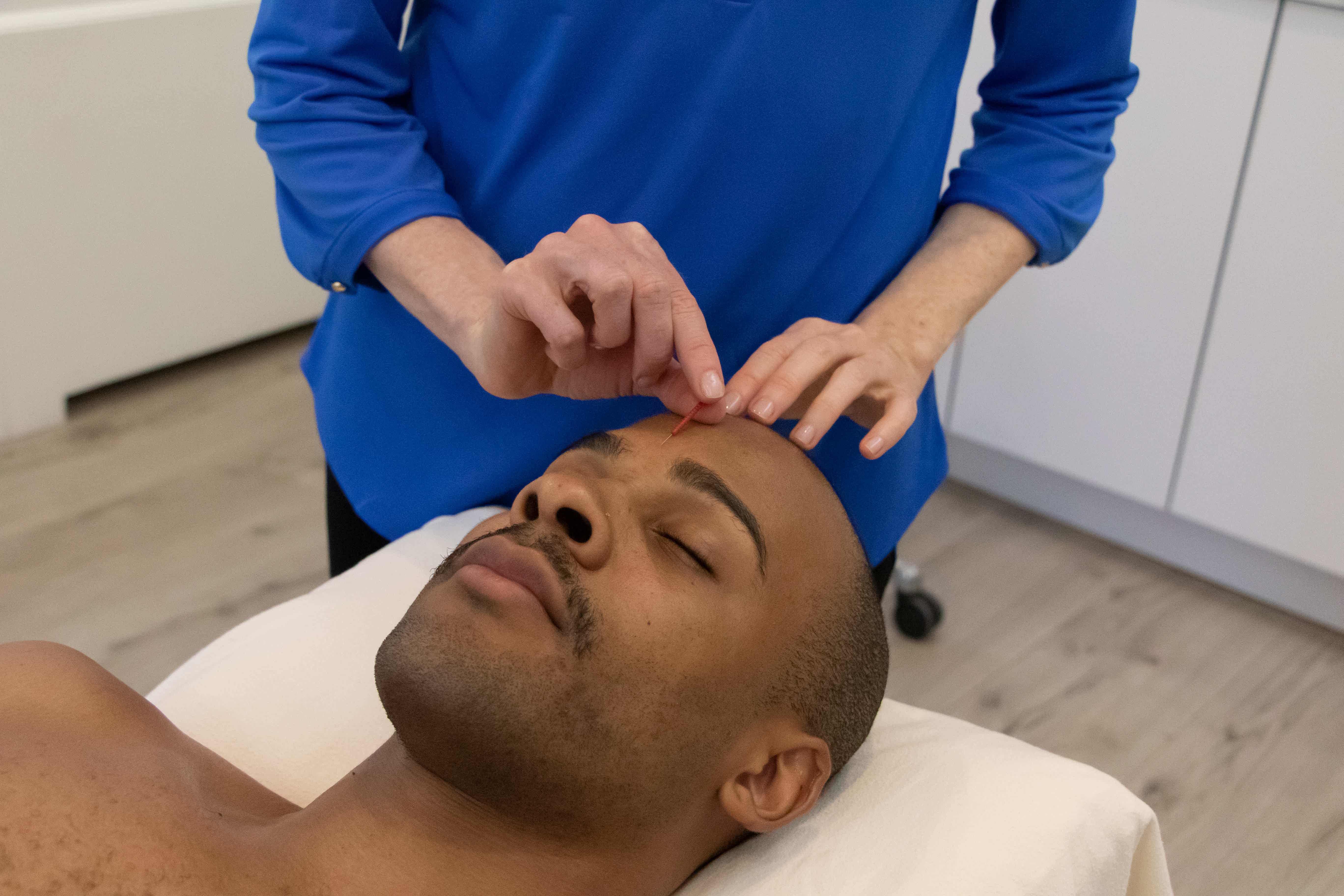
Yin Tang, between the eyebrows — one of the most reliably calming points on the body, often the first place we go for anxiety or a racing mind
None of these replace treatment, but they're simple ways to keep the nervous system leaning in the right direction between visits.
Ready to Regulate Your Nervous System?
Acupuncture has been working with the body's regulatory systems for thousands of years — modern research is just now giving us the imaging and data to show how. If you're feeling wired, under-recovered, or simply curious what a more balanced nervous system could do for your sleep, stress, and resilience, we'd love to help you find out.
We are committed to providing personalized care tailored specifically to your needs—ensuring you receive the most effective treatment possible for expedited recovery. Have questions before you book? Visit our FAQ.
Meet our knowledgeable practitioners or schedule your visit below.
References
This content is for educational purposes and is not a substitute for individualized medical advice.