How Acupuncture and Cosmetic Acupuncture Support Perimenopausal Women: Evidence-Based Insights
Understanding Perimenopause: Why Do These Changes Happen?
Perimenopause is a natural transition, but for many women in their 40s, it can feel like a sudden shift away from feeling optimal. Symptoms often appear gradually—trouble sleeping, brain fog, new fatigue, changes in body shape, skin texture, and even hair thinning. You’re not alone if you’ve noticed these changes and wondered when things started to feel different.
---------
Evidence at a Glance:
- Acupuncture can reduce hot flashes and night sweats (Liu C et al.,2022)
- Improves sleep quality and reduces insomnia (Cao et al., 2009)
- Supports mood, anxiety, and emotional balance (Zhao FY et al., 2023)
- Enhances skin hydration, collagen, and hair growth (Dhurat et al., 2013)
- May support hormone regulation and cardiovascular health (Lin G et al., 2023; Leem J.,2016; Zijlstra et al., 2003)
----------
As women approach menopause, estrogen levels begin to decline. Research shows that estrogen can decrease by about 1–2% each year during perimenopause, with a more rapid drop in the final 1–2 years before menopause (Burger et al., 2007). By menopause, estrogen levels are roughly 10–20% of premenopausal levels (Santoro & Randolph, 2011).
Why Estrogen Matters: The Many Roles of Estrogen in the Body
Estrogen is a master regulator, influencing nearly every system in the body. As levels decline, a wide array of symptoms can emerge—sometimes all at once, sometimes gradually. Here’s how estrogen supports key body functions and why its loss can feel so disruptive:
Brain Function & Cognitive Clarity: Supports neurotransmitter production and blood flow in the brain, helping with memory, focus, and mood. Lower estrogen is linked to increased brain fog, forgetfulness, and mood changes (Hara et al., 2015).
Sleep Regulation: Helps regulate melatonin and serotonin, hormones critical for restful sleep. As estrogen drops, sleep can become lighter, more fragmented, and less restorative (Baker et al., 2018).
Skin Hydration & Collagen Production: Boosts collagen and natural oil production, keeping skin plump, hydrated, and elastic. Declining estrogen leads to thinner, drier skin, more fine lines, and changes in facial contours (Raine-Fenning et al.,2003).
Fat Distribution & Metabolism: Controls how the body stores fat, especially around the abdomen. Lower estrogen is linked to increased central fat, bloating, and metabolic changes (Lovejoy et al., 2008).
Bone Density: Essential for bone remodeling and calcium absorption. Its decline accelerates bone loss, raising the risk of osteoporosis (Riggs et al., 2002).
Muscle Recovery: Plays a role in muscle repair and inflammation control. Lower levels can mean more soreness, slower recovery after workouts, and a greater tendency toward injury (Enns & Tiidus, 2010).
Hair Growth: Prolongs the growth phase of hair follicles. As levels fall, hair may thin, shed more easily, and regrow more slowly (Thornton et al., 2003).
Cardiovascular & Immune Function: Estrogen helps protect heart health and modulate immune response, which is why cardiovascular risk and inflammation can rise after menopause (Lee et al., 2016; Zijlstra et al., 2003).
Vaginal & Urinary Health: Supports tissue health and function in the pelvic region; decline can cause dryness, discomfort, and urinary symptoms (Kim et al., 2017)
Because estrogen influences so many systems, its gradual loss can create a cascade of symptoms—sometimes subtle, sometimes pronounced. This is why perimenopausal changes can feel so diverse and unpredictable.
How Acupuncture Supports Perimenopausal Women: Key Areas
Sleep Quality & Insomnia
Acupuncture has been shown to improve sleep quality, reduce insomnia, and help reset circadian rhythms. It may increase melatonin secretion and decrease nighttime awakenings, making sleep more restorative (Cao et al., 2009; Huang et al., 2022).
Hot Flashes & Night Sweats
Evidence shows acupuncture can reduce both the frequency and severity of hot flashes and night sweats, two of the most common and disruptive perimenopausal symptoms (Liu C et al., 2022).
Mood, Anxiety & Emotional Balance
By regulating neurotransmitters like serotonin and dopamine, acupuncture supports mood stability, reduces anxiety, and helps with irritability or low mood (Zhao FY et al., 2023)
Skin, Hair & Cosmetic Wellness
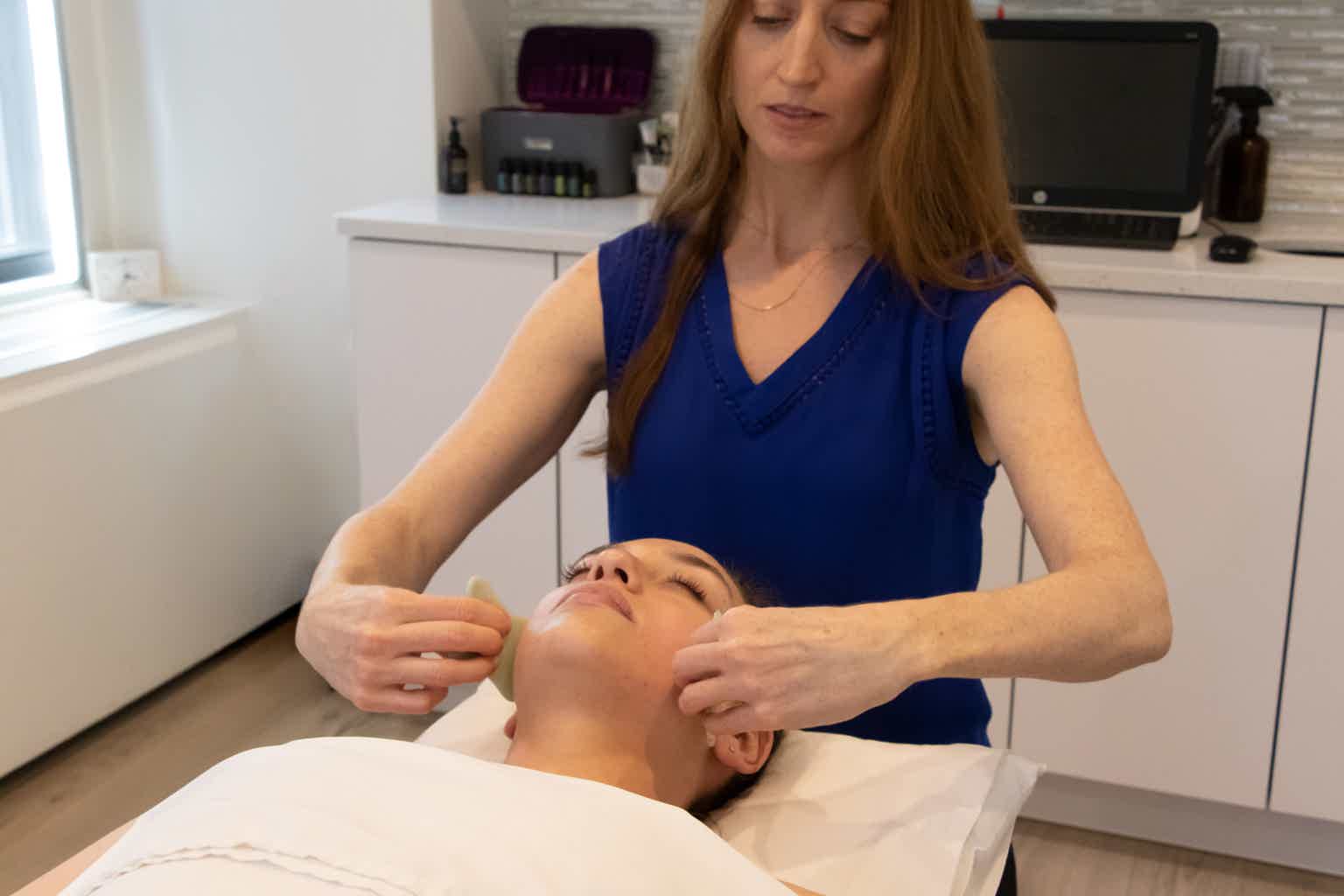
Cosmetic acupuncture and microneedling can boost local blood flow, stimulate collagen and elastin, and improve muscle tone and facial contours. Scalp acupuncture and microneedling may slow hair loss and support regrowth (Dhurat et al., 2013).
Hormone Regulation
While acupuncture doesn’t replace hormones, it may support the body’s regulatory axis (HPO axis), helping smooth out hormone fluctuations and reduce symptom severity (Lin G et al., 2023).
Digestive & Metabolic Support
Acupuncture can improve brain-gut communication, support digestion, and help reduce bloating and metabolic sluggishness (Pang B et al., 2016).
Cardiovascular & Immune Health
May help regulate blood pressure, improve circulation, and modulate inflammation and immune response (Leem J.,2016; Zijlstra et al., 2003).
Vaginal & Urinary Health
Emerging studies suggest acupuncture can improve vaginal dryness, urinary frequency, and pelvic floor function, enhancing comfort and quality of life (Zhou J, Qu F.,2009).
A Holistic Approach: Acupuncture at Revive + Root Plus Lifestyle
Acupuncture works best alongside lifestyle shifts—nutrient-rich diet, improved sleep, stress management, and targeted supplements or herbal medicine. At Revive + Root, we use an integrative approach which can help restore your body’s natural balance, improve energy, sleep, skin, and overall wellbeing.
If you’re experiencing perimenopausal changes, know that you have options beyond just coping. Acupuncture and cosmetic acupuncture offer evidence-based, holistic support to help you feel and look your best—inside and out.
Watch our Holistic Beauty Webinar to learn more about how cosmetic acupuncture and microneedling can support you skin, confidence, and wellbeing, or schedule your visit now to experience personalized care.
References
Burger HG, Dudley EC, Robertson DM, Dennerstein L. Hormonal changes in the menopause transition. Recent Prog Horm Res. 2002;57:257-75.https://pubmed.ncbi.nlm.nih.gov/12017547/
Santoro N, Randolph JF Jr. Reproductive hormones and the menopause transition. Obstet Gynecol Clin North Am. 2011;38(3):455-66. https://pubmed.ncbi.nlm.nih.gov/21961713/
Hara Y, Waters EM, McEwen BS, Morrison JH. Estrogen effects on cognitive and synaptic health over the lifecourse. Physiol Rev. 2015;95(3):785-807. https://pubmed.ncbi.nlm.nih.gov/26109339/
Baker FC, de Zambotti M, Colrain IM, Bei B. Sleep problems during the menopausal transition: prevalence, impact, and management challenges. Nat Sci Sleep. 2018;10:73-95.https://pubmed.ncbi.nlm.nih.gov/29445307/
Raine-Fenning NJ, Brincat MP, Muscat-Baron Y. Skin aging and menopause : implications for treatment. Am J Clin Dermatol. 2003;4(6):371-8.https://pubmed.ncbi.nlm.nih.gov/12762829/
Lovejoy JC, Champagne CM, de Jonge L, Xie H, Smith SR. Increased visceral fat and decreased energy expenditure during the menopausal transition. Int J Obes (Lond). 2008;32(6):949-58. https://pubmed.ncbi.nlm.nih.gov/18332882/
Riggs BL, Khosla S, Melton LJ 3rd. A unitary model for involutional osteoporosis: Estrogen deficiency causes both type I and type II osteoporosis in postmenopausal women and contributes to bone loss in aging men. J Bone Miner Res. 2002;17(1):11-16.https://pubmed.ncbi.nlm.nih.gov/9610739/
Enns DL, Tiidus PM. The influence of estrogen on skeletal muscle: Sex matters. Sports Med. 2010;40(1):41-58. https://pubmed.ncbi.nlm.nih.gov/20020786/
Thornton MJ, Taylor AH, Mulligan K, Al-Azzawi F, Lyon CC, O'Driscoll J, Messenger AG. The distribution of estrogen receptor beta is distinct to that of estrogen receptor alpha and the androgen receptor in human skin and the pilosebaceous unit. J Invest Dermatol Symp Proc. 2003;8(1):100-103. https://pubmed.ncbi.nlm.nih.gov/12895004/
Liu C, Wang Z, Guo T, Zhuang L, Gao X. Effect of acupuncture on menopausal hot flushes and serum hormone levels: a systematic review and meta-analysis. Acupunct Med. 2022 Aug;40(4):289-298. https://pubmed.ncbi.nlm.nih.gov/34894774/
Zhao FY, Zheng Z, Fu QQ, Conduit R, Xu H, Wang HR, Huang YL, Jiang T, Zhang WJ, Kennedy GA. Acupuncture for comorbid depression and insomnia in perimenopause: A feasibility patient-assessor-blinded, randomized, and sham-controlled clinical trial. Front Public Health. 2023 Feb 6;11:1120567. https://pubmed.ncbi.nlm.nih.gov/36815166/
Cao H, Pan X, Li H, Liu J. Acupuncture for treatment of insomnia: a systematic review of randomized controlled trials. J Altern Complement Med. 2009;15(11):1171-86. https://pubmed.ncbi.nlm.nih.gov/19922248/
Huang W, Kutner N, Bliwise DL. A systematic review of the effects of acupuncture in sleep disturbance. Sleep Med Rev. 2022;61:101567. https://pubmed.ncbi.nlm.nih.gov/19097814/
Lin G, Liu X, Cong C, Chen S, Xu L. Clinical efficacy of acupuncture for diminished ovarian reserve: a systematic review and meta-analysis of randomized controlled trials. Front Endocrinol (Lausanne). 2023 Aug 2;14:1136121. https://pubmed.ncbi.nlm.nih.gov/37600702/
Leem J. Acupuncture to treat hypertension: a recent systematic review and implications for subsequent research. Integr Med Res. 2016 Mar;5(1):69-71. https://pmc.ncbi.nlm.nih.gov/articles/PMC5381419/
Zijlstra FJ, van den Berg-de Lange I, Huygen FJ, Klein J. Anti-inflammatory actions of acupuncture. Mediators Inflamm. 2003;12(2):59-69. https://pubmed.ncbi.nlm.nih.gov/12775355/
Lund KS, Siersma V, Brodersen J, Waldorff FB. Efficacy of a standardised acupuncture approach for women with bothersome menopausal symptoms: a pragmatic randomised study in primary care (the ACOM study). BMJ Open. 2019 Feb 19;9(1):e023637. https://pmc.ncbi.nlm.nih.gov/articles/PMC6501989/
Pang B, Jiang T, Du YH, Li J, Li B, Hu YC, Cai QH. Acupuncture for Functional Dyspepsia: What Strength Does It Have? A Systematic Review and Meta-Analysis of Randomized Controlled Trials. Evid Based Complement Alternat Med. 2016;2016:3862916. https://pmc.ncbi.nlm.nih.gov/articles/PMC5227170/
Zhou J, Qu F. Treating gynaecological disorders with traditional Chinese medicine: a review. Afr J Tradit Complement Altern Med. 2009 Jul 3;6(4):494-517. https://pmc.ncbi.nlm.nih.gov/articles/PMC2816470/
Dhurat R, Sukesh M, Avhad G, Dandale A, Pal A, Pund P. A randomized evaluator blinded study of effect of microneedling in androgenetic alopecia: A pilot study. Int J Trichology. 2013;5(1):6-11. https://pmc.ncbi.nlm.nih.gov/articles/PMC3746236/
The 2023 nonhormone therapy position statement of The North American Menopause Society. Menopause. 2023 Jun 1;30(6):573-590. https://pubmed.ncbi.nlm.nih.gov/37252752/